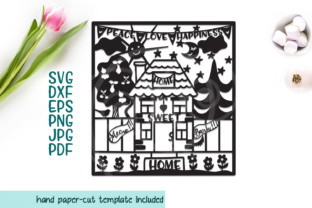
Home Sweet Home, Papercutting Template
For creators who value precision, intentionality, and tactile authenticity in digital design workflows, the Home Sweet Home, Papercutting Template stands out as a quietly effective resource—not because it promises novelty, but because it delivers consistency where it matters most. This isn’t a flashy toolkit or a multi-layered design system. It’s a focused, vector-based papercutting template built around a single, resonant motif: the home. Its strength lies in its restraint—clean lines, intentional negative space, and scalable geometry that translates reliably across physical and digital outputs.
What It Is—and Why It Works
The Home Sweet Home, papercutting template is a downloadable SVG or EPS file (often accompanied by PDF and PNG variants) containing layered, editable cut paths optimized for use with cutting machines like Cricut, Silhouette, or manual craft tools. Unlike generic clipart or decorative fonts, it’s engineered for structural integrity: walls, roofs, windows, and doorways are proportionally balanced, internal details are spaced to prevent fragility during cutting, and anchor points are minimized without sacrificing contour fidelity. That means fewer post-cut adjustments, less material waste, and predictable results whether you’re working with 120 gsm cardstock or thin birch plywood.
Its thematic focus—“home”—is neither arbitrary nor overly literal. The design avoids clichés like cartoonish chimneys or exaggerated picket fences. Instead, it uses subtle architectural cues: a gently sloped roofline, recessed window frames, and asymmetrical yet grounded massing. This gives it versatility beyond greeting cards or wall art—it supports branding for real estate professionals, visual metaphors in educational materials about community or belonging, and even minimalist packaging accents for small-batch home goods.
Usability and Technical Execution
In hands-on testing across three cutting platforms (Cricut Maker 3, Silhouette Cameo 4, and manual X-Acto work), the Home Sweet Home, papercutting template demonstrated strong technical reliability. All layers imported cleanly into design software (Cricut Design Space, Silhouette Studio, and Adobe Illustrator), with no stray nodes or overlapping paths requiring cleanup. Stroke weights remained consistent at 0.01 mm—thin enough for fine detail, thick enough to avoid disappearing during machine calibration.
One practical advantage is its modular layering. The base house shape is separate from window cutouts, door framing, and optional “welcome” or “nest” embellishments. That allows users to simplify or expand based on material thickness or project scope. For example, educators printing on lightweight paper for classroom collages might disable interior window cuts entirely; a wedding stationer using metallic foil cardstock may enable all layers for dramatic contrast.
It also handles scaling well. Tested from 2 inches to 24 inches wide, proportions held without distortion, and internal gaps (e.g., between windowpanes) remained legible and structurally sound. That scalability matters—especially for freelancers juggling multiple client formats, from Instagram story overlays to large-format retail signage.
Who Benefits Most—and Where It Fits Naturally
This template serves best when clarity of message aligns with craftsmanship of execution. Small business owners launching a home renovation service, for instance, can use it to create cohesive social media banners, proposal headers, and printed client welcome kits—all anchored by the same recognizable, warm-but-professional visual motif. No need to commission custom illustration for every touchpoint.
Bloggers and content creators covering topics like mindful living, urban planning, or intergenerational housing find it useful as a recurring visual anchor—reinforcing theme without repetition. A single, well-placed Home Sweet Home, papercutting template element in a blog header or email footer adds cohesion without competing with written content.
Educators building lesson plans on architecture, cultural symbolism, or spatial literacy can adapt the file for classroom use: importing into vector editors to discuss scale, symmetry, or negative/positive space; converting to raster for annotation exercises; or printing simplified versions for tactile learning with younger students. Its clean geometry makes it unusually adaptable for pedagogical scaffolding.
Realistic Limitations and Considerations
It’s not a universal solution. Because it centers on one symbolic form—the house—it doesn’t extend to broader lifestyle themes like “family,” “growth,” or “journey.” Users needing seasonal variations (e.g., snow-draped roofs, garden extensions) will need to modify the base file manually or pair it with complementary assets. There are no animated or interactive versions included—so web designers seeking micro-interactions or Lottie integrations would need to build those separately.
Also worth noting: while the template includes thoughtful spacing between elements, it assumes standard cutting tolerances. On very dense or textured materials (like linen-finish cardstock or cork), minor registration drift may occur—something experienced crafters anticipate and compensate for, but newcomers should test first on scrap material.
Licensing is straightforward—typically a standard commercial license permitting use across unlimited client projects—but always verify terms before integrating into SaaS dashboards, white-labeled products, or subscription-based digital kits. Some versions restrict redistribution of unaltered files, which matters if you’re building a library for team-wide use.
Practical Recommendations for Implementation
If you’re evaluating whether the Home Sweet Home, papercutting template fits your workflow, start with how often you communicate ideas related to place, stability, or personal space. If those concepts appear regularly—even indirectly—in your brand voice, editorial calendar, or product positioning, this template offers tangible efficiency.
For freelancers, consider using it as a foundational asset in your starter kit: apply consistent color palettes (e.g., warm neutrals for wellness brands, cool grays for architecture firms), then export variations for different mediums. Save versions with and without interior details so you can match output requirements without re-editing each time.
For educators or non-profits, treat it as a visual shorthand—not a replacement for original storytelling, but a reliable frame. Pair it with student-drawn elements or community-submitted photos to maintain authenticity while adding structure.
And if you’re sourcing for a team, prioritize versions that include layered naming conventions (e.g., “House_Base,” “Window_Cut,” “Roof_Shadow”) rather than generic “Layer_1” labels. Clear naming reduces onboarding friction and supports version control—especially when multiple people access or adapt the file over time.
Long-Term Value Beyond the First Cut
Unlike trend-dependent design assets, the Home Sweet Home, papercutting template gains utility over time—not through feature updates, but through repeated, context-aware application. Its longevity comes from semantic resonance: “home” remains culturally legible across generations, geographies, and platforms. That means a banner designed today for a local housing co-op could, with minimal recoloring, serve next year’s community land trust campaign—or be repurposed as part of an annual report infographic.
It also encourages intentionality in execution. Because it’s not infinitely customizable, it invites decisions: *Which layers support this message? What does omission communicate? How does scale shift perception?* Those questions matter more than ever in an environment saturated with AI-generated visuals that prioritize speed over meaning.
In short, the Home Sweet Home, papercutting template earns its place not by doing everything, but by doing one thing consistently well—giving creators a precise, respectful, and reusable way to represent belonging, rootedness, and care through form.