Dead Admirer Logo Template: A Practical Evaluation for Designers and Brands
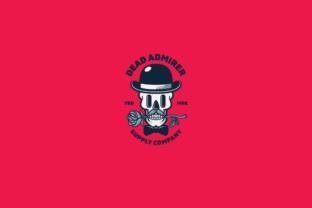
The Dead Admirer Logo Template is a pre-designed, customizable logo file—typically delivered in vector (AI, EPS, SVG) and raster (PNG, JPG) formats—intended for immediate use or adaptation. It features a stylized, often gothic or alternative aesthetic, commonly incorporating motifs like skulls, roses, ornate typography, or monochrome contrast. Unlike custom logo design services or generic logo makers, this template occupies a middle ground: it offers visual distinctiveness and thematic cohesion out of the box, while requiring some design literacy to modify effectively.
People explore the Dead Admirer Logo Template for several interrelated reasons. Some are launching niche creative ventures—such as independent music labels, tattoo studios, apparel lines, or dark-themed content channels—and seek branding that signals authenticity within subcultural contexts. Others operate with tight timelines or constrained budgets and need a starting point that avoids generic stock imagery. Still others use it as a reference or mood anchor during early brand development—testing how a particular visual language resonates before investing in original design.
One clear benefit of the Dead Admirer Logo Template is efficiency. With layered, editable files, users can adjust colors, swap fonts (where permitted by licensing), resize elements, or integrate supporting graphics without rebuilding from scratch. Its thematic consistency reduces the risk of mismatched visual cues—a common pitfall when assembling disparate design assets. For teams with basic Adobe Creative Cloud access—or designers comfortable with vector editing—it provides a tangible foundation that supports iteration rather than replacement.
However, tradeoffs exist. Customization requires technical familiarity. Users unfamiliar with layer management in Illustrator or font embedding rules may struggle to achieve professional output. Licensing terms vary significantly across sources: some versions permit commercial use only with attribution; others restrict merchandise resale or prohibit modification altogether. Without careful review, users risk legal exposure or inconsistent application—especially if the template includes third-party fonts or icons not included in the package.
Another important consideration is brand longevity. While the Dead Admirer Logo Template delivers strong immediate identity, its recognizability depends heavily on context. In saturated markets—like indie fashion or metal-adjacent media—similar aesthetics appear frequently. Without thoughtful differentiation (e.g., unique color variants, bespoke taglines, or intentional layout shifts), the logo may blend in rather than stand out. Long-term brand equity also hinges on scalability: does the design hold clarity at small sizes (app icons, social avatars) and large formats (signage, merch)? Not all templates are optimized equally across these dimensions.
The Dead Admirer Logo Template tends to be a strong fit in specific scenarios. It works well for time-bound projects where visual alignment matters more than exclusivity—for example, promoting a limited-run album, launching a seasonal collection, or branding a short-form video series with defined tonal boundaries. It’s also appropriate when internal design capacity exists but external budget does not—say, a small studio with a graphic designer who can adapt the template to match existing brand guidelines. Additionally, educators or workshop facilitators sometimes use it as a teaching tool to demonstrate logo anatomy, hierarchy, and file preparation—making abstract concepts concrete for learners.
Conversely, alternatives may be preferable in other cases. If brand differentiation is a strategic priority—especially in competitive, visually driven industries like beauty, tech, or publishing—a fully custom logo remains the most reliable path to uniqueness and trademark viability. Similarly, organizations planning multi-year campaigns, international expansion, or extensive merchandising should weigh whether a template-based solution supports consistent evolution. Free or low-cost logo generators offer speed but often lack stylistic nuance or export flexibility; conversely, hiring a freelance designer brings tailored solutions but requires vetting, briefing, and revision cycles.
Licensing clarity is a decisive factor in evaluating the Dead Admirer Logo Template. Before downloading or purchasing, verify whether the license covers your intended use case: commercial products, digital platforms, client work, or resale. Check whether font files are embedded or require separate licensing. Confirm whether modifications must be “substantial” to avoid attribution requirements. When in doubt, consult the vendor’s documentation or contact support directly—don’t rely solely on marketplace summaries, which may oversimplify restrictions.
Technical readiness matters too. Assess your team’s comfort level with vector editors. Can you isolate layers, adjust paths, manage transparency, and export correctly sized PNGs with transparent backgrounds? If not, allocate time for learning or consider pairing the template with light professional assistance—such as a one-hour consultation with a designer to handle core adaptations. Skipping this step often leads to pixelated outputs, misaligned elements, or inconsistent color reproduction across media.
Finally, consider audience perception holistically. A logo isn’t evaluated in isolation—it appears alongside tone of voice, photography style, user experience, and product quality. The Dead Admirer Logo Template communicates a specific mood, but does that mood align with how your audience experiences your offering? For instance, a wellness brand using dark, gothic visuals may unintentionally signal austerity over care. Conversely, a horror-comedy podcast benefits from the irony and genre awareness such a template conveys. Let audience expectations—not just personal preference—guide the choice.
Decision-making starts with intention. Ask yourself: Is this logo primarily functional (a placeholder for launch), expressive (a deliberate statement of identity), or transitional (a bridge to future custom work)? If functional, prioritize ease of use and broad compatibility. If expressive, invest time in meaningful customization—even minor tweaks like adjusting stroke weight or repositioning negative space can strengthen resonance. If transitional, treat the template as a brief: document what works and what doesn’t, then share those insights with a designer later.
In summary, the Dead Admirer Logo Template is neither a shortcut nor a compromise—it’s a tool with defined scope and conditions for success. Its value emerges not from novelty alone, but from how deliberately it’s selected, adapted, and integrated into a broader brand system. For creators who understand its constraints and align them with realistic goals, it offers a pragmatic entry point. For those seeking singular distinction, scalable flexibility, or long-term legal certainty, exploring alternatives remains a sound and responsible choice.