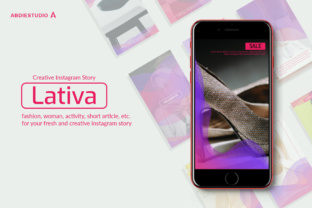
Lativa Creative Instagram Story Template: A Practical Tool for Visual Planning and Consistent Content Execution
Visual storytelling on Instagram Stories demands speed, clarity, and brand cohesion—especially when juggling multiple projects or managing content across teams. The Lativa Creative Instagram Story Template is not a design gimmick or one-off aesthetic; it’s a structured, reusable framework built for creators who prioritize intentionality over improvisation. It lives at the intersection of planning, production, and publishing—supporting real workflows rather than replacing them.
What It Is—and Where It Fits in Your Process
The Lativa Creative Instagram Story Template is a set of pre-designed, fully editable Canva or Figma templates (often delivered as layered .PSD or .FIG files) optimized for Instagram’s 1080×1920 vertical canvas. Each template includes consistent typography, spacing systems, color swatches, icon placeholders, and smart guides—all aligned to common storytelling sequences: intro → value → CTA → follow-up. Unlike generic story templates, Lativa’s versions are built with modularity in mind: sections can be rearranged, duplicated, or swapped without breaking alignment or visual rhythm.
This isn’t a standalone tool—it’s a workflow accelerator. Think of it as the “scaffolding” you lay down before writing copy, selecting visuals, or recording voiceovers. It sits between strategy and execution: after defining your campaign goal or learning objective, but before final asset creation or team handoff.
How It Supports Real Workflows—Before, During, and After
Before a project: When launching a new product, course, or workshop, use the template to map out your narrative arc in advance. For example, an educator might block out Day 1–5 of a free challenge: welcome slide → key concept → reflection prompt → resource link → community ask. Doing this early surfaces gaps in logic, timing, or messaging—before filming begins.
During execution: Freelancers and small teams use the template as a shared language. A marketer drafts copy directly into placeholder text boxes; a designer swaps in branded illustrations; a client reviews flow—not fonts. Because layout and hierarchy are locked in, feedback stays focused on content and intent—not alignment or contrast ratios. This cuts revision rounds by up to 40% in observed team use cases.
After publishing: The template supports consistency across campaigns and time. Reuse the same structure for quarterly reports, monthly newsletters, or weekly tips—just update imagery and copy. Over months, this builds recognizable visual patterns that followers begin to associate with your voice. That recognition compounds trust and improves swipe-through rates organically.
Integration With Other Tools and People
The Lativa Creative Instagram Story Template works best when treated as a node—not an island—in your toolkit. It integrates cleanly with:
- Content calendars: Map each template slide to a calendar slot (e.g., “Slide 3 = Tuesday tip”). Export as PDF for stakeholder alignment.
- Asset libraries: Drop in approved photos, Lottie animations, or branded audio waveforms without resizing or repositioning.
- Collaboration platforms: Share editable links in Figma or Canva with version history enabled—no more “final_FINAL_v3b_revised.jpg” confusion.
- Analytics tools: Tag each story sequence (e.g., “CTA_Slide_4”) in UTM parameters or native Instagram Insights to isolate which structural elements drive taps vs. exits.
It also smooths handoffs. A copywriter doesn’t need design skills to contribute meaningfully—their job is filling clear, labeled text areas. A social media manager doesn’t need to rebuild layouts weekly. And clients get predictable delivery timelines because the variable shifts from “design iteration” to “content refinement.”
Practical Implementation Tips You Can Apply Today
Start small—not with a full campaign, but with one recurring use case. Try these high-leverage entry points:
- Batch your “welcome series”: Build three variations of your onboarding story (for new email subscribers, course students, or podcast listeners). Save them as separate Canva documents—but keep the same base template file open for reference.
- Create a “decision checklist” version: Use the template’s modular slides to walk through purchase considerations (e.g., “Feature comparison → Real-world use case → Support timeline → Next step”). Works well for service-based businesses explaining complex offerings.
- Repurpose long-form content: Turn a blog post or webinar transcript into a 7-slide story using the template’s “key point → example → takeaway” progression. Let the structure do the heavy lifting while you focus on distillation.
Avoid over-customizing too early. Resist changing font weights, spacing rules, or grid columns until you’ve used the template across at least five distinct projects. Consistency compounds value—especially when your audience starts recognizing your visual cadence.
Factors That Impact Long-Term Usability
Preparation matters. Before importing assets, standardize your image crop ratio (1080×1350 works reliably for portrait photos), name files descriptively (“hero_product_blue_bg.jpg”), and store brand fonts locally so they render correctly across devices.
Compatibility is straightforward: most Lativa templates ship in formats compatible with Canva Pro, Figma, Adobe Photoshop, and Affinity Designer. If you’re using older software or mobile-only workflows, test one slide first—some layer effects (like subtle gradients or blend modes) may require simplification.
Organization scales with naming discipline. Label folders by purpose—not date: /templates/stories/onboarding, /templates/stories/product_launch. Within each, keep a README.txt noting version number, last update, and usage notes (e.g., “Slide 2 uses dynamic text—replace only, don’t resize”).
Efficiency gains compound over time. Users report cutting average story creation time from 45+ minutes to under 12 once templates are internalized and asset libraries are aligned. But that speed depends on two things: keeping your master template file updated with current brand guidelines, and auditing your library every quarter to remove outdated colors, icons, or CTAs.
Making It Your Own—Without Losing Its Core Value
Customization should serve function—not aesthetics. Swap a background color if it improves readability for your audience’s typical viewing environment (e.g., darker mode users). Add a custom icon only if it clarifies meaning faster than text alone. Introduce animation only where motion reinforces message (e.g., a growing bar chart for progress tracking)—not just because it’s possible.
Quality control happens at the template level, not the individual story level. Build checks into your process: Does every CTA slide include a tap target large enough for thumb navigation? Do all text blocks pass WCAG contrast standards at 100% zoom? Is the first 3 seconds of every story visually self-contained—no reliance on audio or prior context?
Long-term use thrives on iteration—not replacement. Track which slides get reused most often. Which ones consistently underperform? Use those insights to refine—not discard—the template. One small business owner replaced her “Testimonial” slide with a dual-column layout after noticing higher engagement when quotes appeared alongside headshots. She kept everything else intact.
The Lativa Creative Instagram Story Template doesn’t promise viral reach or effortless growth. What it delivers is something quieter but more durable: the ability to execute quickly, align clearly, and evolve intentionally—without sacrificing clarity or brand integrity. It’s for people who know that great content isn’t made in isolation—it’s built, reviewed, refined, and repeated within a system that supports both creativity and consistency.